Nature risk is
business risk.
Darwin quantifies nature and physical climate risk for investors and the companies they back — in euros, across portfolios and value chains.
BOOK A DEMO
Trusted by industry leaders










Who we work with
Private equity funds
Screen, diligence and monitor nature and physical climate exposure across every portfolio company, consolidated at fund level.
Infrastructure & real asset funds
Asset-level hazards, dependencies and upstream materials impact, in the variables your model runs on.
Impact funds
Measure and steer your nature contribution with auditable indicators your LPs can trust.
Corporates & their advisors
The same platform, for companies and for the consultancies that deliver nature strategies with them.
Nature risk is now a portfolio risk.
Water stress, floods, heat, pollinator loss and supply-chain fragility are showing up in asset values, permitting timelines and operating margins. Regulators and LPs now expect investors to know where that exposure sits in their portfolio and what it is worth.
Siloed tools leave most of the exposure unpriced.
Climate, biodiversity, water and pollution are one system — what IPBES calls the nexus. Yet most assessments measure carbon alone, screen a single hazard, or stop at the asset boundary. The result is a portfolio view with blind spots exactly where the material risks sit: upstream, in dependencies, and in the interactions between pressures.
One model, from portfolio to value chain.
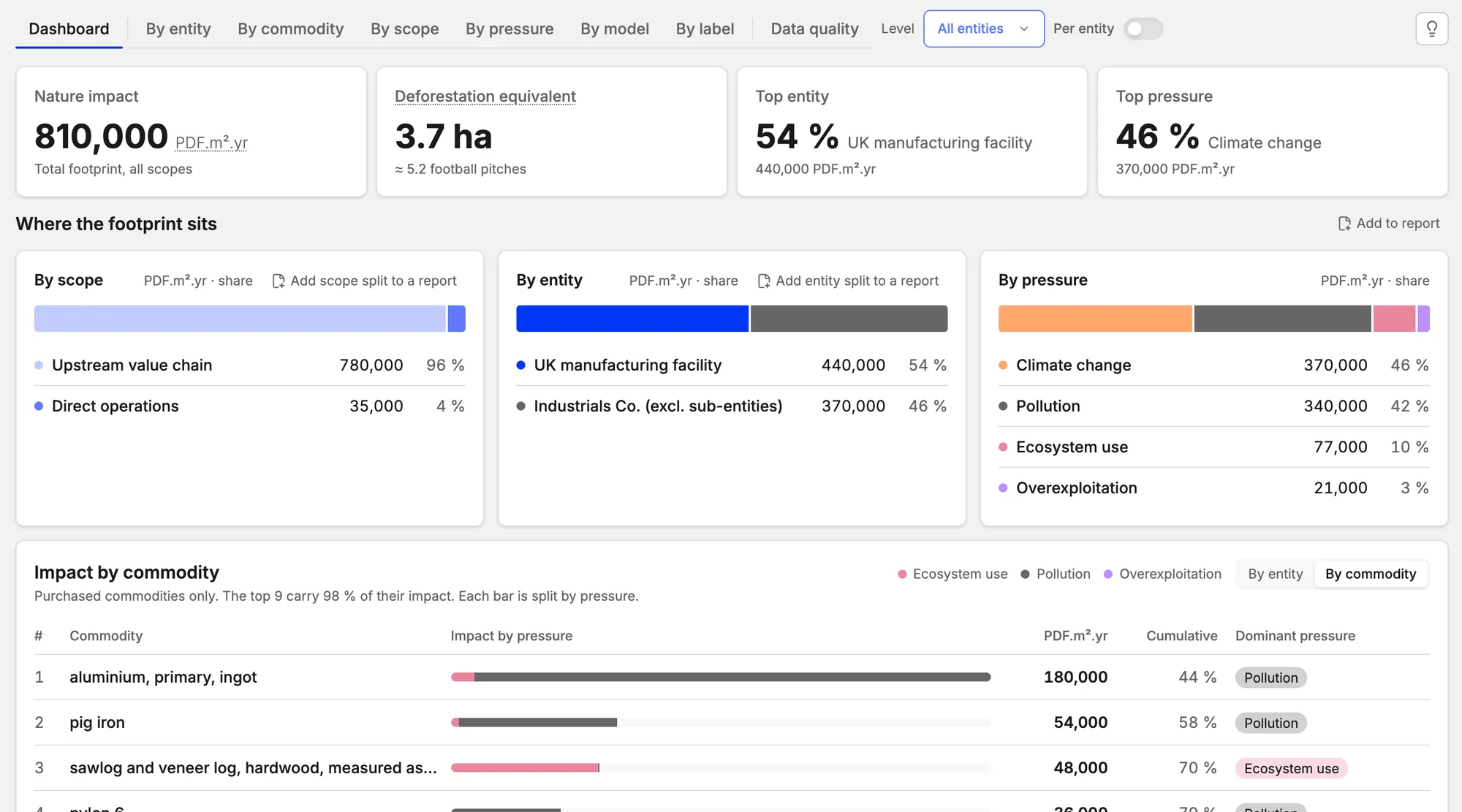
Darwin assesses impacts, dependencies and physical and transition risks across all 5 environmental pressures in a single model, for each company and consolidated at fund level. It starts from the data you already hold and extends to upstream and downstream value chains without supplier surveys. The output is one coherent view, in euros, that an investment committee can act on.
Value proposition
What we offer.

Screen and diligence with the data you already have
- Map physical and transition risk across a target or a whole portfolio from turnover and procurement data, before any questionnaire goes out.
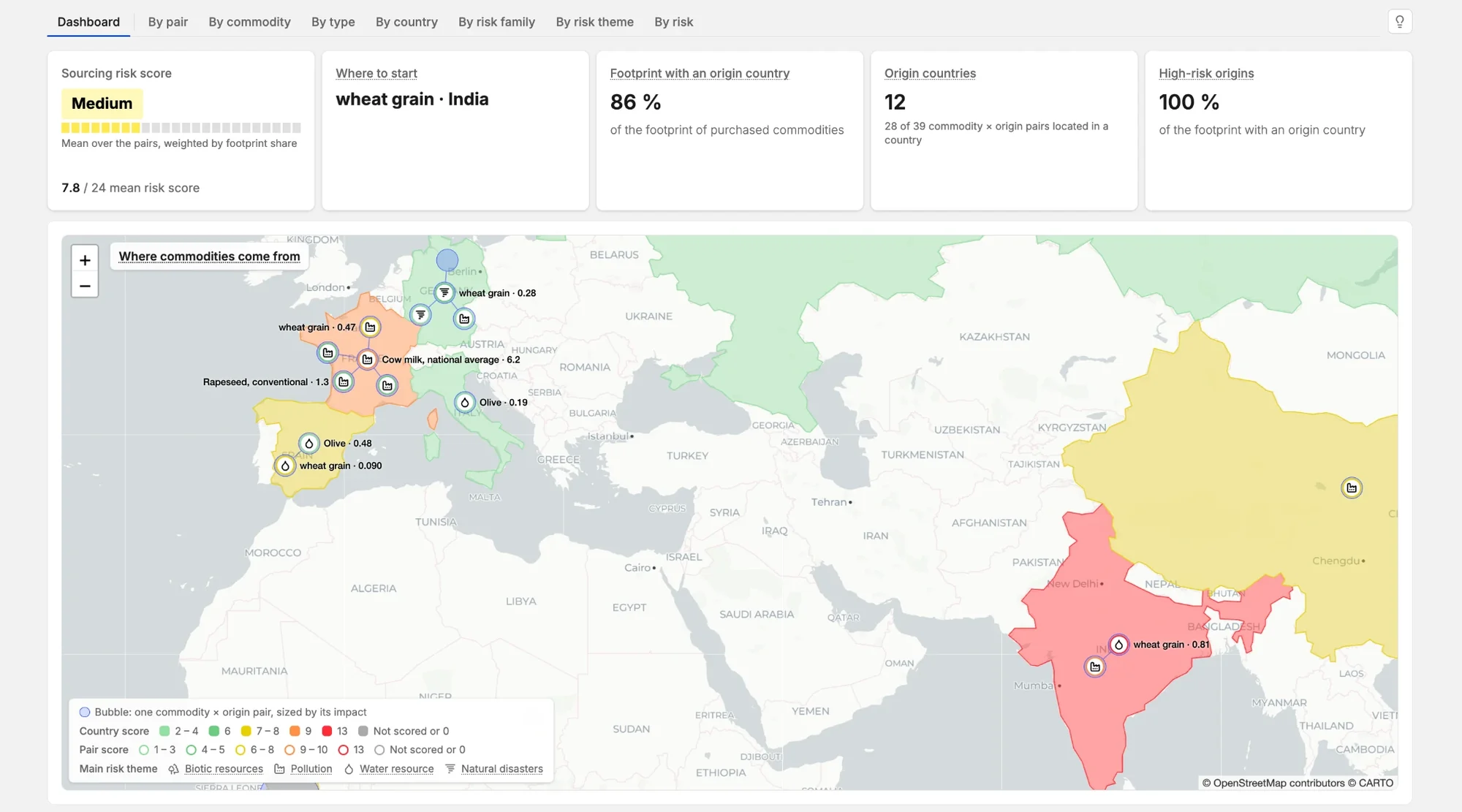
- Rank sites, commodities and suppliers by exposure and surface the deal-relevant red flags.
- Get a first portfolio-wide view in under 2 hours, not after a 6-month engagement.
- For companies: the same screening runs on your own sites and sourcing, whether or not your investor asked for it.
Quantify exposure in euros
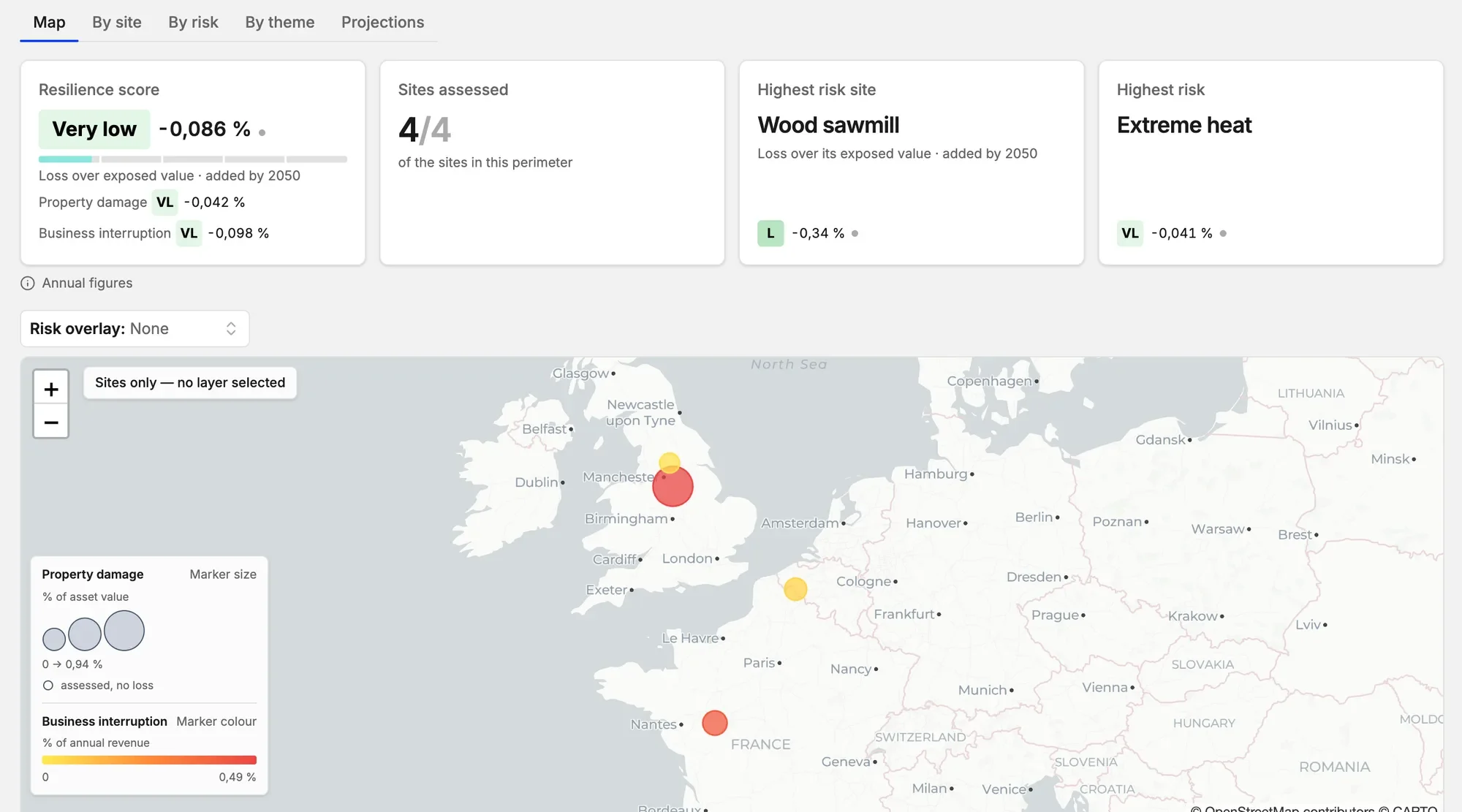
- Translate each risk driver into an expected annual loss per site, today and at 2035, 2050 and 2080, under 3 SSP scenarios.
- Separate physical damage from business disruption, and climate hazards from ecosystem-service dependencies, without double counting.
- Consolidate at holding and fund level to see where value is actually at stake.
- For companies: put a financial number on nature and climate risk that speaks to your CFO, your bank and your insurers.
Build value-creation plans
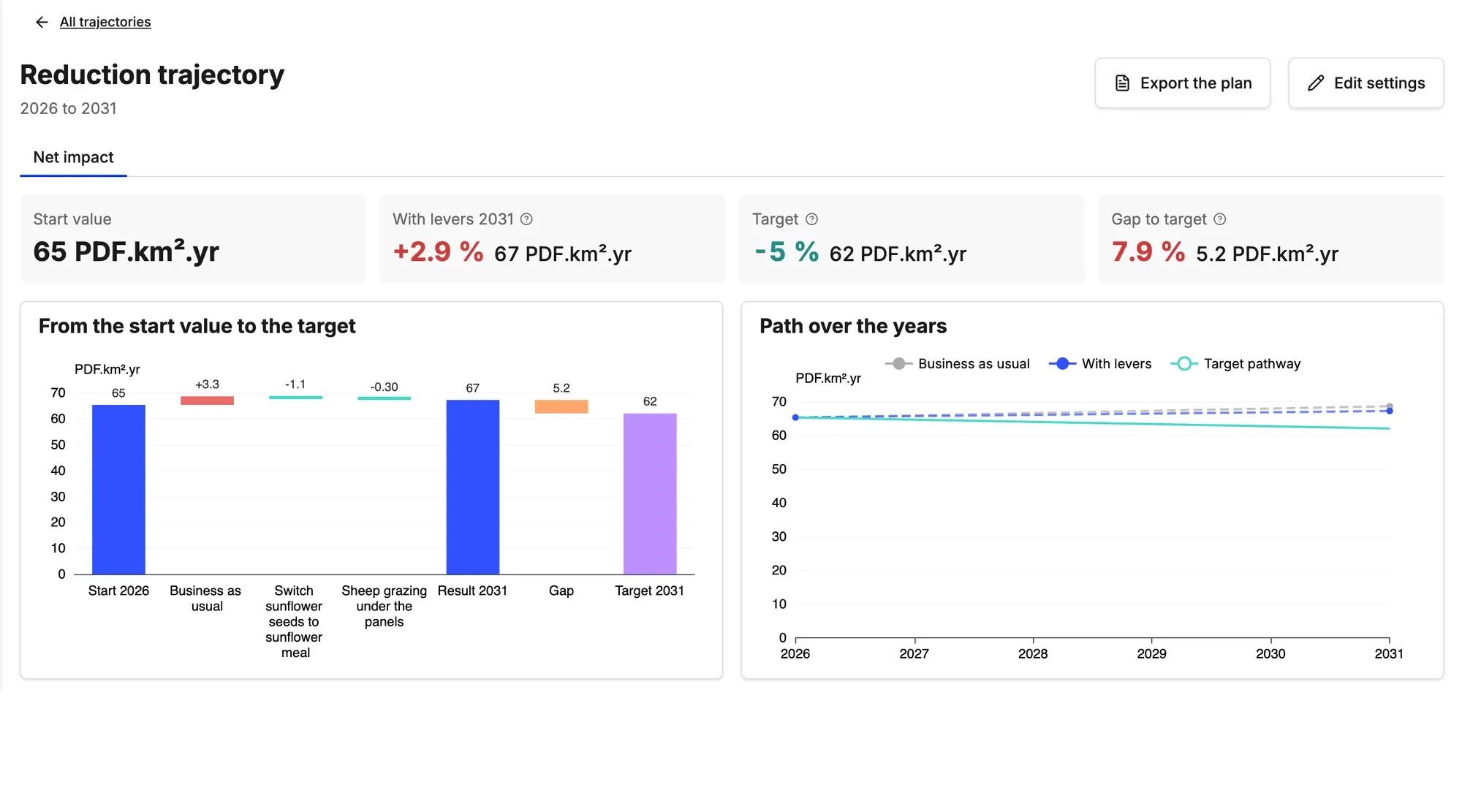
- Turn every material exposure into a catalogue of concrete actions and test them in scenario simulations.
- Set KPIs on the pressures that matter for each company and track them across the hold period.
- Quantify avoided impacts against a business-as-usual baseline to substantiate the exit story.
- For companies: model sourcing and operational changes before committing capital, and prove what you have already done.
Report to LPs and regulators
- Aggregate company assessments into fund-level disclosures under SFDR (incl. PAI), EU Taxonomy, CSRD, Article 29 LEC, TNFD and TCFD / IFRS S2.
- Export custom portfolio and portfolio-company reports and framework data packs directly from the platform.
- Give LPs decision-grade figures rather than qualitative ratings.
- For companies: answer investor, client and tender questionnaires with auditable numbers instead of statements.
Featured in



Our product
Our platform is fully modular and flexible.
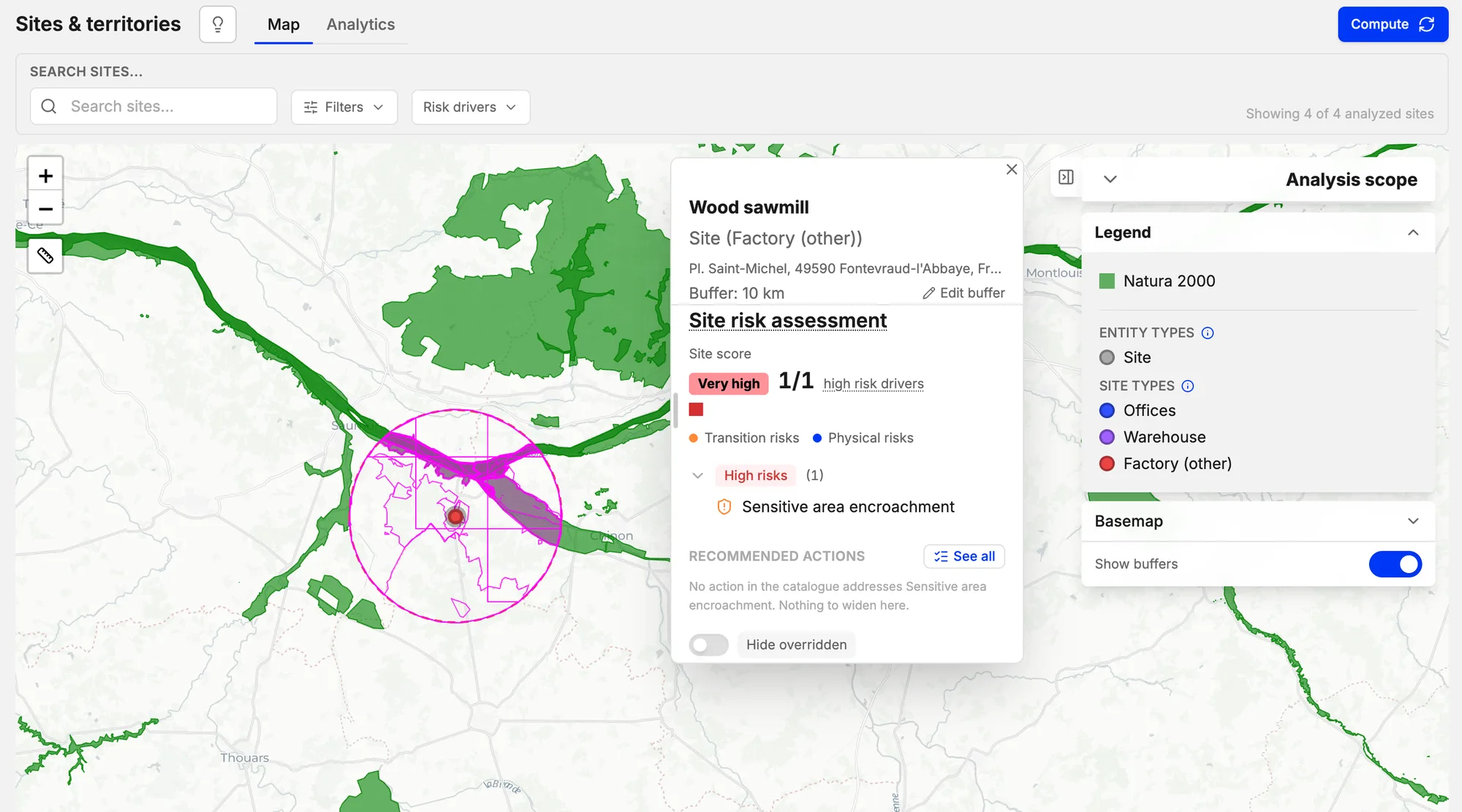
Our modules cover every stage of nature strategies, from data collection to footprinting, risks assessment, spatial analysis, target-setting, action planning, and reporting. We leverage advanced technologies — Big Data, AI, and geospatial intelligence — to streamline the entire process and make it scalable.
Built-in AI
- Charles Our AI agent, in the platform
- Open API Darwin in your systems
- MCP Darwin in Claude, ChatGPT or Copilot
What we model
Select a family to see what it covers
Acute and chronic hazards, read at the exact location of each site and supplier.
For example
- Floods
- Heat stress
- Drought
- Storms
- Wildfires
- Sea-level rise
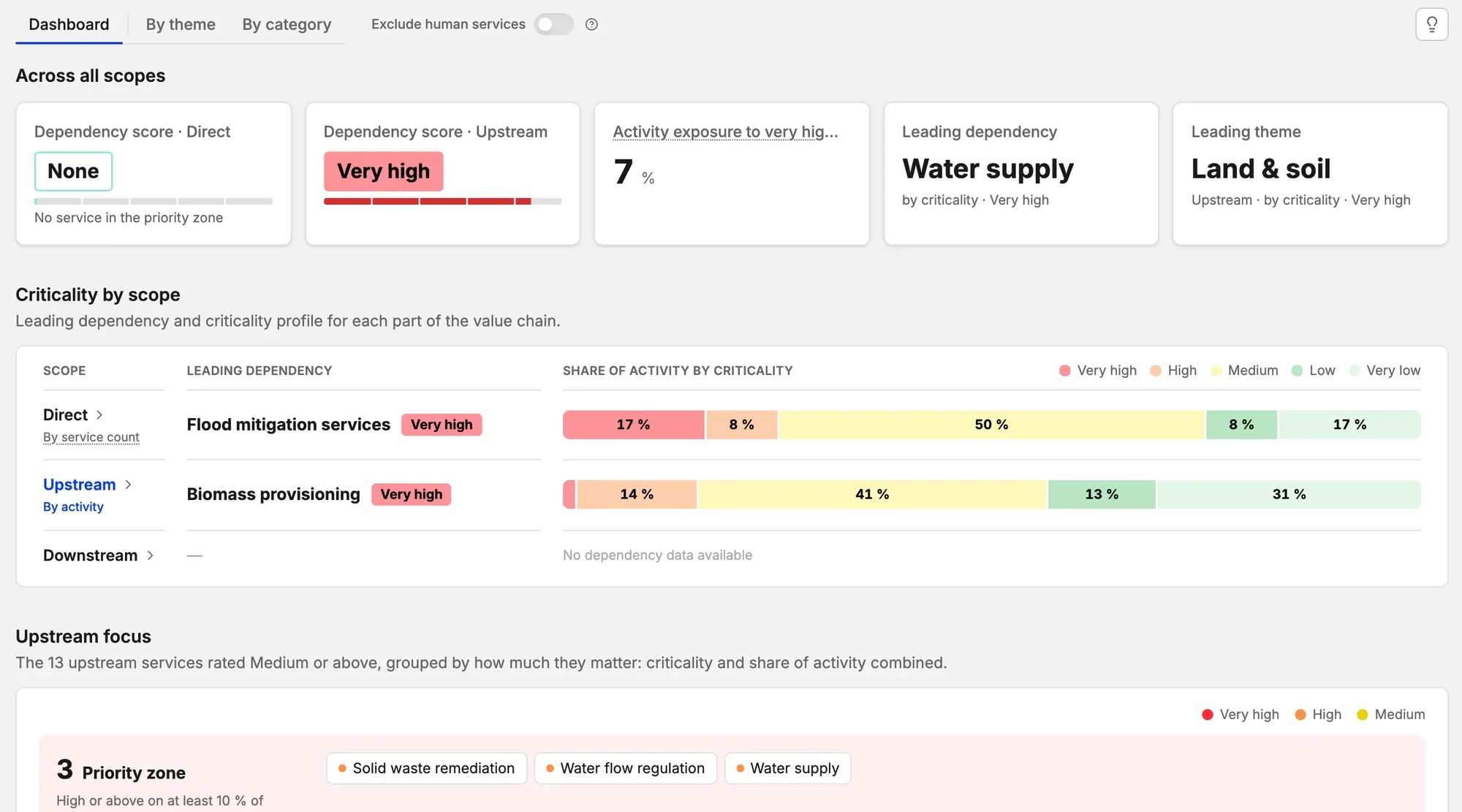
Losses when the ecosystem services your operations and suppliers depend on degrade.
For example
- Water supply
- Pollination
- Soil quality
- Erosion control
- Water purification
- Flood protection
Regulatory, market and reputational costs tied to your pressures on nature, across the value chain.
For example
- Land-use change
- Over-exploitation
- Pollution
- Invasive species
- Sensitive areas
Today + 3 time horizons
- Today
- 2035
- 2050
- 2080
Every driver is translated into an expected annual loss in euros, under 3 SSP scenarios, today and at 2035, 2050 and 2080 — for your own operations and for your value chain.
“Tracking biodiversity impact rigorously requires more than good intentions — it demands the right infrastructure. Darwin provides exactly that: automated monitoring and evaluation of our key indicators, giving us a transparent, real-time view of our impact. It's become a cornerstone of how we steer and report on our biodiversity action plan with the rigour our investors expect.”

Quentin Simon
Investment Director, Starquest
“Beyond the pleasure of working with the team, we value Darwin's 'one-stop-shop' approach, which brings together all the tools & methodologies needed to assess nature issues. From spatial screening (in due diligence) to biodiversity footprinting (for our portfolio assets), we now have the tools to manage our impacts more precisely and identify actionable levers.”
Audrey Lambry
Sustainability Director, Eurazeo
In a nutshell
Darwin in a nutshell
Nature & Climate, united
Physical climate risk, biodiversity, water and pollution — all assessed together in a single environment. No more siloed tools or fragmented views: Darwin connects every environmental pressure so you see the full picture, and the trade-offs between them.
Actionable, not just a score
Every risk we surface is tied to concrete mitigation levers — through our action catalogue, our scenario-simulation tool and our AI co-pilot. You don’t just get a rating; you get a clear path to reduce exposure and build resilience.
Anchored in financial materiality
We translate nature exposure into euros — current risk, future losses to 2050, and the value at stake across your operations and value chain. Decision-grade numbers, not qualitative ratings.
Resources
Our perspectives
ESRS E4 after the July 2026 revision: what is required on biodiversity, and how to get there with the data you already have
Read More
The same risk, modelled twice: why climate and nature are 2 models of one exposure
Read More
Climate is just one lens on physical risk — nature shows the full picture
Read MoreReady to turn nature risks into opportunities?
Join the leading companies that use Darwin to understand, measure, and act on their nature-related impacts and dependencies.
BOOK A DEMO